
Blog
Forex Risk Analysis: Practical Strategies for Managing Market Uncertainty
Forex Broker in Iran is one of many resources traders explore while comparing brokerage services, but regardless of where an account is opened, long-term success in the foreign exchange market depends far more on risk management than on finding the next winning trade.
Forex Broker in Iran is one of many resources traders explore while comparing brokerage services, but regardless of where an account is opened, long-term success in the foreign exchange market depends far more on risk management than on finding the next winning trade.
Ask experienced traders what separates consistent performers from those who disappear after a few months, and the answer rarely begins with indicators or trading strategies. More often, it starts with capital preservation. The foreign exchange market offers exceptional liquidity and nearly continuous trading opportunities, but those same characteristics also expose traders to sudden volatility, unexpected news events, and emotional decision-making.
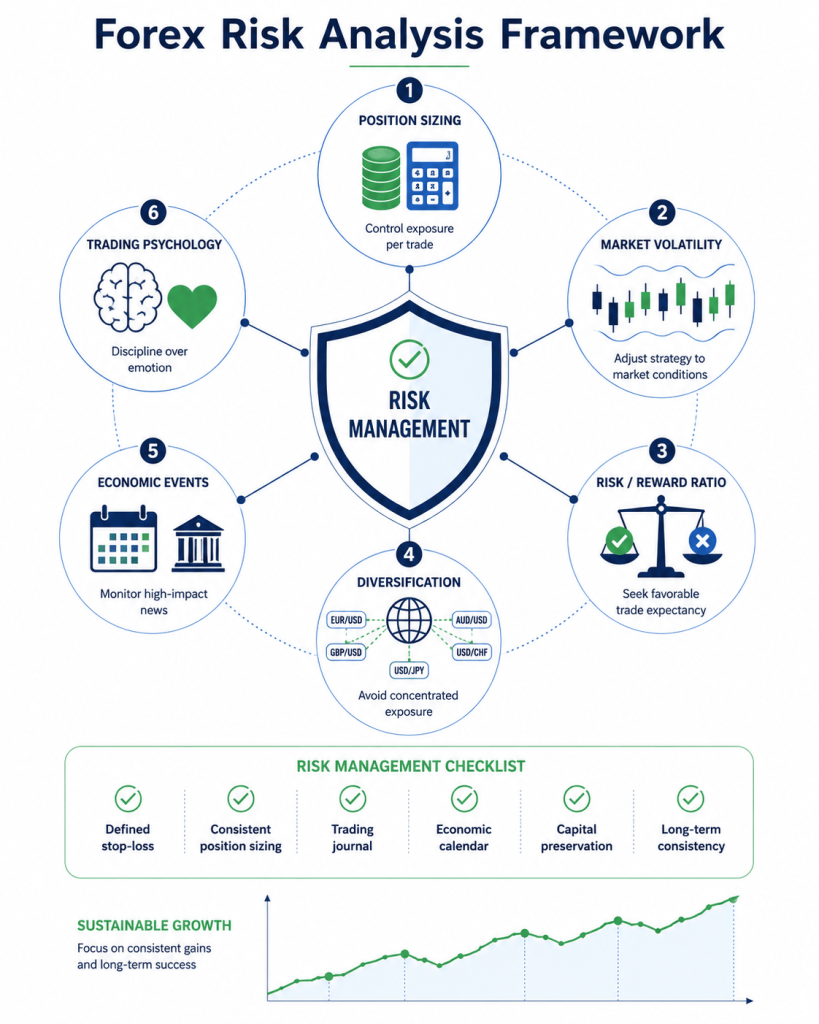
Risk analysis is therefore not a secondary consideration. It is the framework that allows every other part of a trading strategy to function effectively.
Understanding Risk Beyond Price Movements
Many newcomers define risk simply as the possibility of losing money on a trade. Professional traders view it much more broadly. Market risk is only one component among several that influence trading performance.
Other forms of risk include:
- Unexpected macroeconomic events.
- High-impact political announcements.
- Liquidity shortages during volatile sessions.
- Technology failures and internet interruptions.
- Execution delays and slippage.
- Emotional decision-making under pressure.
Recognizing these variables allows traders to prepare for situations that cannot be predicted with complete accuracy.
Position Sizing Is the First Line of Defense
One of the most overlooked aspects of risk management is position sizing. Even an excellent trading strategy can fail if individual positions expose too much capital.
Professional traders typically determine position size before entering the market rather than adjusting it afterward. They begin by deciding how much of their total trading capital they are willing to risk on a single position, then calculate the appropriate lot size based on stop-loss distance.
This structured approach prevents individual trades from causing disproportionate damage to the overall portfolio.
Volatility Changes Everything
The Forex market does not move with the same intensity every day. Currency pairs may trade quietly during one session and experience sharp price swings after central bank announcements or major economic releases.
Ignoring volatility often leads traders to place stop-loss orders that are either too tight or excessively wide. Both scenarios create unnecessary risk.
Monitoring indicators such as the Average True Range (ATR), historical volatility, and economic calendars helps traders adapt position sizing and trade management to changing market conditions.
The Relationship Between Risk and Reward
Winning frequently is not necessarily the objective. Many consistently profitable traders maintain winning percentages well below 60 percent because they carefully manage the relationship between potential reward and acceptable risk.
| Risk-to-Reward Ratio | Potential Outcome | Long-Term Perspective |
|---|---|---|
| 1:1 | Equal gain and loss potential | Requires a relatively high win rate |
| 1:2 | Reward twice the risk | Greater margin for occasional losses |
| 1:3 or higher | Larger potential upside | Allows profitability despite lower win rates |
The goal is not to maximize gains on every trade but to build a statistical advantage over hundreds of trading decisions.
Diversification Matters in Currency Trading
Diversification in Forex is often misunderstood. Opening positions in multiple currency pairs does not necessarily reduce exposure if those pairs are strongly correlated.
For example, several positions involving the U.S. dollar may effectively represent a single directional view on the dollar itself. Similarly, commodity-linked currencies often respond to similar macroeconomic developments.
Understanding correlation helps traders avoid unintentionally concentrating risk.
The Psychological Dimension of Risk
Even well-designed trading plans can fail if emotions override discipline. Fear may encourage traders to close profitable positions prematurely, while overconfidence often results in excessive leverage after a series of successful trades.
Maintaining a trading journal allows market participants to review not only technical decisions but also emotional responses to different market conditions.
Patterns become easier to identify when traders document why positions were opened, how they were managed, and whether the original trading plan was followed.
Economic Events Require Special Attention
The Forex market reacts quickly to economic data releases. Inflation reports, employment statistics, GDP figures, and central bank policy decisions frequently produce rapid price movements.
Professional traders generally prepare for these events in advance by reviewing economic calendars and considering several possible market scenarios rather than relying on a single prediction.
Sometimes the most effective risk management decision is choosing not to trade during periods of exceptional uncertainty.
Building a Sustainable Risk Framework
A comprehensive risk management process typically includes:
- Clearly defined maximum account risk.
- Consistent position sizing rules.
- Predefined stop-loss placement.
- Realistic profit objectives.
- Regular performance reviews.
- Emotional discipline supported by written trading plans.
These elements work together to create consistency across changing market environments.
Conclusion
Risk analysis is not designed to eliminate uncertainty. Financial markets will always remain unpredictable to some extent. Instead, effective risk management provides a structured way to operate within that uncertainty while protecting trading capital.
Successful Forex traders understand that profitability is rarely determined by a single exceptional trade. More often, it results from hundreds of disciplined decisions made over time, each supported by thoughtful analysis, controlled exposure, and a willingness to prioritize long-term consistency over short-term excitement.
Frequently Asked Questions
Why is risk management more important than predicting market direction?
Even accurate market forecasts can produce losses if position sizes are too large or trades are poorly managed. Risk management helps limit the impact of inevitable losing trades.
How much capital should be risked on a single Forex trade?
Many experienced traders limit exposure to a small percentage of total trading capital on each position, helping preserve their account during periods of market uncertainty.
Does diversification always reduce risk in Forex?
No. Currency pairs can be highly correlated, meaning several positions may effectively increase exposure to the same underlying market movement.
Can risk analysis guarantee profitable trading?
No risk management method can eliminate losses. Its purpose is to control exposure, improve consistency, and increase the likelihood of sustainable long-term performance.